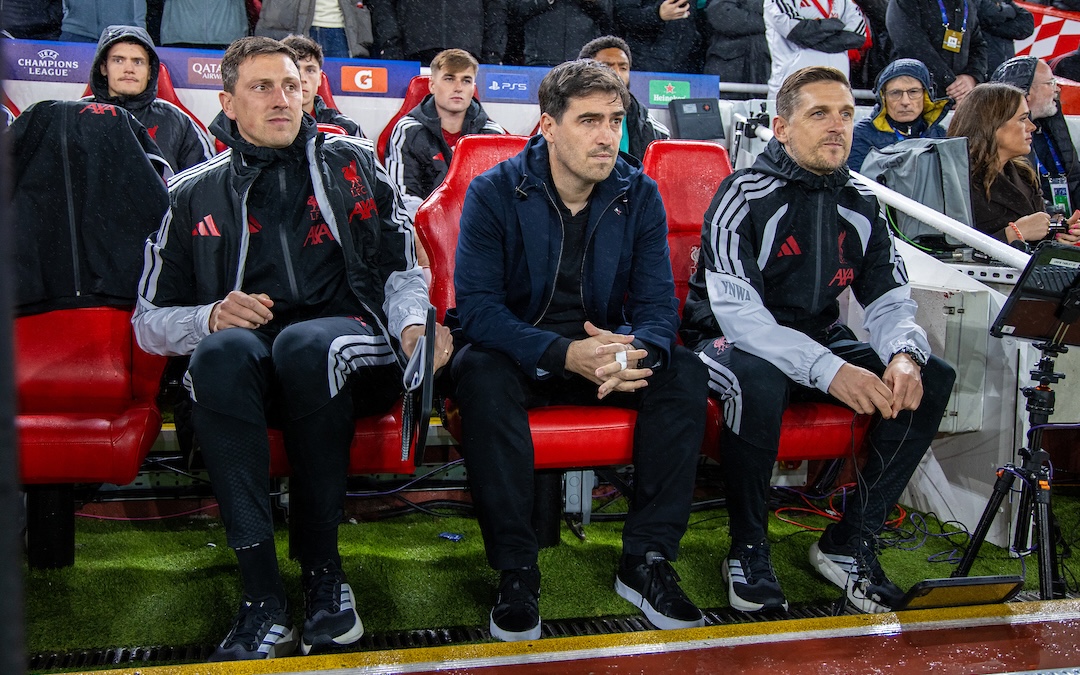
While members of the mainstream media continue to question if Liverpool are a fallen giant, Andoni Iraola’s team are quietly building…
WHEN Jamie Carragher sat down with Andoni Iraola in the summer, he reassured the Spaniard that he would get time and patience.
Carragher was right to say it, and Iraola would be right to expect it, given the range of issues he walked into following the abomination of 2025-26.
Three months in, Iraola would be justified in reminding Carragher of that encounter a few times already this season.
While Carragher is far from the only critical voice, his quest to see Florian Wirtz outed from Liverpool’s lineup would have been as welcome as a bout of tinnitus to Iraola.
Carragher was at least more positive about Liverpool and their number seven after the win at Brentford, but his former teammate Danny Murphy was in a less praising mood.
Murphy chose Liverpool’s second win in five years at a stadium where they’ve routinely been bullied and outsmarted to highlight the flaws of Iraola’s team.
‘Liverpool are far too easy to play through’, said Murphy, who went on to produce clips to back up his argument, which claimed they allowed Brentford out without pressing man for man and when they did, the backline didn’t squeeze up enough.
If you believe Murphy, Liverpool only came away from Brentford with a win because they were eventually reduced to nine men.
Coldness and criticism towards Iraola’s men doesn’t just confine itself to ex-Liverpool footballers from the years of 1997-2004 – although I’m bracing myself for some stinging words from Stephane Henchoz, Patrick Berger and Emile Heskey anytime soon.
In general, there is a sense that Liverpool aren’t that headline-worthy. If they win, it’s because they should. It’s the bare minimum a £100million player should produce weekly, and Liverpool have three of them in attack.
If they lose, as they did against Manchester City for the only time this season, there is an avalanche of negativity waiting to fall down on them from every angle, including some of our own supporter base.
By 60 minutes against City, and with a team depleted of star quality following the international break, Liverpool had registered 11 shots to three with an xG of 0.84 to 0.09.
Yes, there’s an argument Liverpool should not be in a position to start Lewis Koumas in a game of this magnitude due to transfer decisions, but Iraola’s side fared better than many would in that situation.
The red card changed everything on the day.
The day after, there were pieces written in national tabloids about the team and stadium being a pale imitation of its former self because we couldn’t stick it to football’s newest enemy in Manchester blue – a club that has been circumventing the rules for well over a decade, but most people only bothered paying attention to once the guilty verdict was delivered.
Somehow, this became Liverpool’s battle to fight. That they couldn’t on the pitch led people to assume they are a spent force currently floating without purpose or direction.
I do think some of this wrongly gets attributed to Iraola himself. The Reds’ boss is extremely polite, calm and amenable. He doesn’t (yet) have any of Jürgen Klopp or Arne Slot’s short-fused dismissiveness when it comes to the mass media rounds he has to fulfil pre and post-match.
He won’t be rallying up the crowd in the same way.
For many on the outside, they don’t see the big personality leading the team, so they assume there’s generally not that much to see.
Pundits seem to expect Bournemouth levels of output from Liverpool. Yet the obvious sign to point to is that Liverpool are a different beast. They play far more high-stakes games and teams simply don’t allow as much space to run into as they would against The Cherries. Iraola has to do this differently and is.
What the neutral observer and pundit isn’t seeing is how Iraola is ensuring Liverpool continue to register wins while navigating fixtures, injuries and embedding his entire ideology of how to play his way.
That their only defeat has basically come from half an hour against City with 10 men – with Alexander Isak, Ryan Gravenberch, Cody Gakpo and Dominik Szoboszlai all missing – is very impressive. Yes, the first two matches and Fulham harboured frustration, but some reactions to those results were over the top.
Media negativity isn’t unusual. The same ambivalence was present in 2024-25 until people realised Slot’s side were genuine title contenders. While it’s annoying, it’s not yet at Rafael Benitez levels, when members of the written press were so offended by his style of play that you felt it undoubtedly influenced and divided the fanbase.
That was still the pre-internet age. The decibels are louder now. Yet, in a good way, the noise at Liverpool is muted. This team is not in the habit of losing, and after last season we should be grateful such a building block has been implemented.
Time and patience. Although we’re not the ones who need reminding.
And if you want to know what an actual club in crisis looks like, let me introduce you to Manchester United Football Club, my friend.